
Current Account Deficit is projected at 1.2 per cent and 1 per cent of GDP in 2014-15 and 2015-16.

The revision of the consumer price index and GDP base years from 2011-12 and 2012, respectively, were dependent on the outcomes of the consumer expenditure survey of 2017-18 that the government decided to junk recently.

Think tank NCAER on Friday said the country's growth rate is likely to be 5.9 per cent, a tad lower than its previous forecast due to slowdown in key manufacturing and services sectors.

Dr Nagesh Kumar, one of the three new MPC members, wanted the MPC to reduce the repo rate by 25 basis points to 6.25%.

The agency attributed the sharp revision to various high-frequency indicators showing a softness and partly blamed the same to reforms like GST, real estate regulation, and the bankruptcy code which are still a "drag" on the economy.

It is projected to cross the $3 trillion mark in 2019

Global trends, macroeconomic data, and the outcome of the US Fed policy meeting are the major factors that will drive the movement in the domestic equity markets this week, analysts said. "In the upcoming data-centric week, the focus will be on crucial releases, including inflation data from India and the US. "Indian inflation is expected to rise, while US inflation will remain steady.

The agriculture sector has witnessed feeble growth on account of drought for two successive years

Comparative to other Asian GDP growths, India would have the fastest economic expansion, it said

In Q1, India's GDP shrank by a staggering 24 per cent year-on-year amid the imposition of one of the most stringent global nationwide lockdowns.

Economic growth has slipped to a six-year low of 5 per cent for the June quarter and is expected to turn in lower than that in the September quarter. Lack of consumption is seen as one of the key factors pulling down growth.

However, the World Bank has projected India's GDP growth rate at 7.5 per cent for the next three financial years, including the current one.

A Reserve Bank-authorised survey on Monday lowered the country's economic growth rate projection to 5.7 per cent for the current fiscal, down from 6 per cent estimated earlier.

India has been relatively insulated from the severe headwinds in the West. However, with a third of the global economy expected to slip into recession in calendar year 2023, the impact will strongly be felt on India's exports and trade economy, leading economists said in a panel discussion at the Business Standard BFSI Insight Summit in Mumbai on Wednesday. The panel comprised former Reserve Bank of India executive director and former Monetary Policy Committee member Mridul Saggar, State Bank of India Chief Economic Advisor Soumya Kanti Ghosh, Citibank India Chief Economist Samiran Chakraborty, ICRA Chief Economist Aditi Nayar, and IndusInd Bank Chief Economist Gaurav Kapoor. The topic of the panel discussion was No recession in sight: Is India decoupled from developed economies?

Macro data have little connect with indicators on the ground.

Rajan had said that there was lack of clarity about the new method.
The agency said announcements by Modi and Finance Minister Arun Jaitley after government formation 'signal a strong intention to pursue reforms'.

The report further said that confidence is improving, while risk aversion is falling and has upgraded industrial production to neutral from negative.

India's economic growth had slumped to a decade's low of five per cent in 2012-13.
The NCEAR has indicated some improvement in the fourth quarter of the current financial year.

According to a research report by Bank of America Merrill Lynch, despite better rains the growth forecast for this fiscal is likely to be around 5.6 per cent.
The surge in investment in manufacturing seems to have prompted the International Monetary Fund to increase the gross domestic product growth forecast to 8.4 per cent for 2007.

Chief Economic Advisor Krishnamurthy Subramanian said India's economy will witness a decline in the current fiscal, but the drop will be limited if there is an economic recovery in the October-March period.
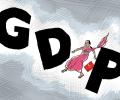
During the six-month period (April-September 2019), the Indian economy grew 4.8 per cent as against 7.5 per cent in the same period a year ago.

Moody's Investors Service on Wednesday slashed India's growth projection to 9.6 per cent for the 2021 calendar year, from its earlier estimate of 13.9 per cent, and said faster vaccination progress will be paramount in restricting economic losses to June quarter.

India is likely to see above-normal rainfall in the four-month monsoon season (June to September) with cumulative rainfall rainfall estimated at 106 percent of the long-period average (87 cm), he said.
Projecting a much better forecast than those made by the government and Reserve Bank of India, economic think tank NCAER on Tuesday said the Indian economy could grow by up to 8.9 per cent during 2008-09, despite a global slowdown.

The Prime Minister's Economic Advisory Council, headed by former Reserve Bank Governor C Rangarajan, had said that it was unlikely that the GDP growth rate would be lower than 6.25 per cent for the current fiscal; buy might reach 6.75 per cent despite the adverse impact of monsoon on farm sector output.

The Reserve Bank of India on Wednesday retained its growth projection at 7.2 per cent for the current fiscal on the back of improvement in urban demand and gradual recovery in rural India. Unveiling the third monetary policy for the current fiscal, RBI Governor Shaktikanta Das said the Indian economy remained resilient, and the central bank will continue to support growth. The RBI expects growth in the first quarter of the current fiscal at 16.2 per cent, which will taper to 4 per cent by the fourth quarter.

Brokerage firm Ambit Capital has cut FY17 growth estimate to 3.5 per cent from 6.8 per cent and saaid there was even a possibility of growth contracting during the December quarter

India's GDP growth for the current fiscal is expected to slow down to 4.8 per cent, a UN report has said, warning that the Covid-19 pandemic is expected to result in significant adverse economic impacts globally. The UN 'Economic and Social Survey of Asia and the Pacific (ESCAP) 2020: Towards sustainable economies' said that Covid-19 is having far-reaching economic and social consequences for the region, with strong cross-border spillover effects through trade, tourism and financial linkages.

IMF projected India's economic growth at 4.25% in 2013-14.

July and August are expected to receive 107 per cent and 104 per cent of rainfall

A piece of slightly negative news can cause a serious setback, warns Debashis Basu.

Equity indices made an emphatic comeback on Friday after falling for seven straight sessions after the RBI hiked interest rates by 50 basis points on expected lines and projected inflation coming under control from January next year. A strong recovery in the rupee added to the momentum, traders said. Overcoming a wobbly start, the 30-share BSE Sensex soared 1,016.96 points or 1.80 per cent to settle at 57,426.92. During the day, it rallied 1,312.67 points or 2.32 per cent to 57,722.63.

As COVID-19 infections spike in the country resulting in restrictions in various states and impacting the fragile recovery, many economists are expecting RBI to delay the policy normalisation move, which is expected in the February review. The country has reported a single-day rise of 58,097 new Covid-19 cases as of Wednesday morning--the highest in around 199 days -- of which 2,135 are Omicron cases and later in the day, the first confirmed Omicron-related death has also been reported. Maharashtra recorded the maximum number of 653 Omicron cases followed by Delhi at 464, Kerala 185, Rajasthan 174, Gujarat 154 and Tamil Nadu 121 cases, taking the total tally of cases to 3,50,18,358.

The RBI has cut key rates to boost the economy.

'The numbers are null and void now. Look, we can give out projections now, but we know that a week later those numbers will also be irrelevant. So we need to wait,' a top government official said.

Defence exports grew 33 per cent in the calendar year 2023 (CY23) to around Rs 21,083 crore while domestic defence orders serviced by listed companies were Rs 48,000 crore. The sector is poised for steady growth. Budgeted domestic capex is likely to hit Rs 3 trillion per annum, and exports could reach $6 billion by FY29.

S&P Global Ratings on Tuesday kept India's economic growth forecast in the fiscal year to March 2022 unchanged at 9.5 per cent but raised its predictions for the subsequent year on broadening out of the recovery. The Indian economy had shrunk by 7.3 per cent in 2020-21 fiscal (April 2020 to March 2021) as pandemic induced restrictions battered business activity. The gradual lifting of the restrictions has helped the economy to rebound from pandemic lows.
